Nos kits contiennent 4 stickers conçus pour répondre aux exigences de visibilité des casques moto : discrets le jour, visibles la nuit, fabriqués en France.
Summary of the legislation on stickers for motorcycle helmets:
Obligatory
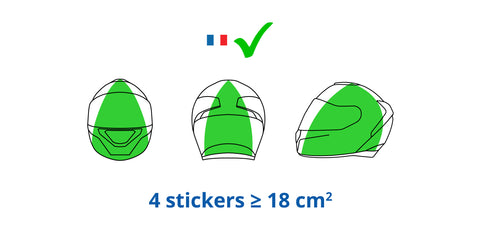
To be homologated in France, a helmet must have the 4 retro reflective stickers stuck on the areas above.
Mandatory retro-reflective stickers on motorcycle helmets
In France, helmets must have 4 retro-reflective strips, under penalty of a 4th class fine for an unapproved helmet: €135 and 3 points less on your licence!
Current French regulations
A motorcycle helmet must have 4 retro-reflective stickers, 1 on each side: at the front (chin or forehead), at the back, on the right, on the left (see diagram above)
The surface of each element must be 18 cm2 minimum, it must be possible to register a circle of 4 cm in diameter OR a rectangle of 12.50 cm2 and 2 cm wide minimum of fully retro-reflective surface.
The stickers must not be torn, bent or impact the operation of the helmet.
Are the black reflective strips homologated?
According to French legislation, to be approved, helmet stickers must reflect in white: white, like black, reflect in white.
Daytime color is not officially regulated and therefore black reflective is not officially approved to date.
This is why a legal vagueness remains present and that certain motorcyclists nevertheless prefer to remain on white stickers so as not to take any risk.
Numerous sources, including gendarmes, have attested to us that the black retro-reflective stickers on the helmets are not subject to a fine, it is the absence of the stickers that is verbalized(-3 points on your license and 135 € fine) .
The power of retro reflection constitutes the most important element (Our 3M Technology™ products are the most effective on the market). In addition, the size, geometry and correct position of the 4 elements of the helmet, as seen above, are checked.
Examples of Compliant Stickers
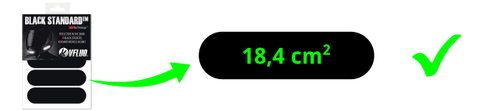
You need a surface of 18cm² minimum and insert a circle of Ø 4cm or a rectangle of 12.5cm²
With the BLACK STANDARD™ stickers, for example, you can make a square with sides of 4.3 cm. That is: (4.3 x 4.3 = 18.4 cm²)
Inserting circles or rectangles
It must be possible to fit in each 18.4 cm2 element: a circle of Ø 4 cm OR a rectangle of 12.50cm²_fully retro-reflecting surface.
Attention, the rectangle must be at least2cm in width!
What are the other approvals for motorcycle helmets?
General approval
In traffic, the motorcyclist must wear an approved helmet correctly attached (Article R431-1 of the Highway Code).
Regardless of the helmet used, it must comply with the ECE-22-04 / ECE-22-05 / ECE-22-06 standards.
In June 2020, the vote on a new standard (ECE 22-06) concerning this certification of motorcycle helmets took place. It involves a more severe test protocol (linear and oblique impact tests, more precise measurement of resistance to shocks caused to the brain, resistance to abrasion, etc.).
Brands that do not comply with this approval will no longer be able to sell their helmets from June 2023.
2. How to prove it?
A helmet is considered approved when it has a white label where the European standard ECE 22-04, ECE 22-05 or ECE 22-06 is mentioned.
On this label we find:
An E followed by a number indicating the country of origin of the approval (2 corresponds to France)
There are then 6 digits starting either with 04, 05 or 06. They represent the amendment number of regulation number 22. France refuses amendment 03 of this same regulation (orange label)
Subsequently, there are one or more letters J ( Jet helmet ), P ( minimal jaw protection ), NP ( does not protect against shocks to the chin ) or JP ( double Jet and Integral homologation )
The production serial number is indicated by the last numbers.
No official indication evaluates the level of protection of helmets, however there is the SHARP test which assigns a rating out of 5 stars.
The texts of laws
Motorcycle helmets must have retro-reflective elements in accordance with Article 6.16 "Signalling" .